
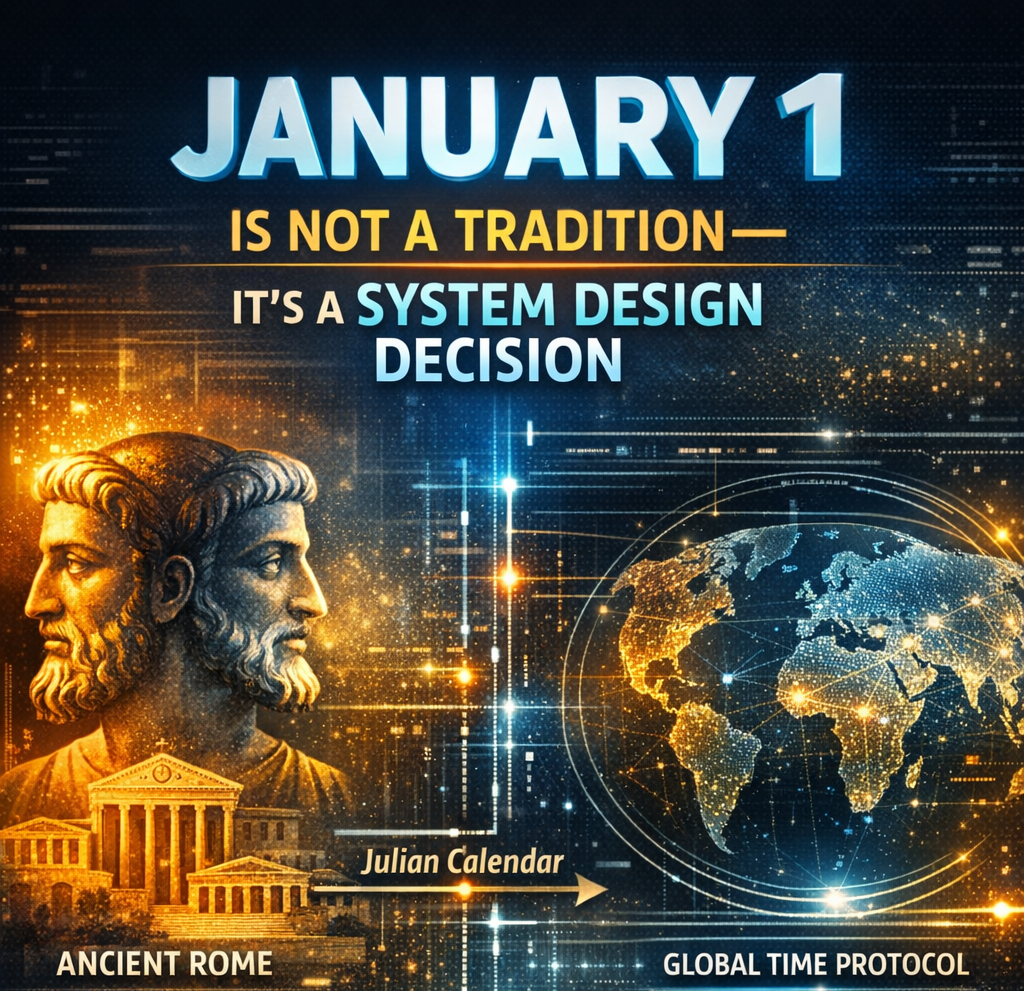
History, Logic, and Global Adoption Explained
Every year, people across the world welcome the New Year on January 1. Fireworks, celebrations, and resolutions mark the beginning of a fresh calendar year. But have you ever wondered why January 1 was chosen as New Year’s Day?
The answer lies in history, calendar systems, and global standardization.
Roman Origins of January 1
The tradition of celebrating New Year on January 1 dates back to ancient Rome. The month of January is named after Janus, the Roman god of beginnings, transitions, and change. Janus is often depicted with two faces—one looking to the past and the other toward the future—making him a symbolic figure for the start of a new year.
Julius Caesar and the Julian Calendar
In 46 BC, Roman emperor Julius Caesar introduced the Julian Calendar.
This reform standardized the Roman calendar and officially declared January 1 as the first day of the year. The goal was to align the calendar with the solar year and bring administrative consistency across the empire.
From a modern perspective, this was one of the earliest examples of time standardization.
Gregorian Calendar Reform
Over centuries, the Julian Calendar accumulated small inaccuracies. To fix this, Pope Gregory XIII introduced the Gregorian Calendar in 1582.
This reform corrected the time drift and reaffirmed January 1 as New Year’s Day. Gradually, European nations adopted this calendar for civil and official use.
Global Adoption of January 1
The global spread of January 1 as New Year’s Day happened through political and colonial influence. The British Empire and its colonies, including the United States, adopted the Gregorian Calendar in 1752.
As international trade, governance, and communication expanded, January 1 became a globally synchronized time standard.
New Year in India
India follows January 1 as the official New Year for administrative and global alignment. However, the country also celebrates multiple traditional New Years based on regional calendars, such as:
- Gudi Padwa (Maharashtra)
- Ugadi (South India)
- Baisakhi (Punjab)
This reflects how multiple calendar systems can coexist, similar to parallel systems in modern technology.
Conclusion
January 1 is not inherently cultural or religious—it is a global system decision shaped by history, reform, and standardization. While cultures celebrate New Year differently, January 1 serves as a common global reset point.





Leave a Reply