
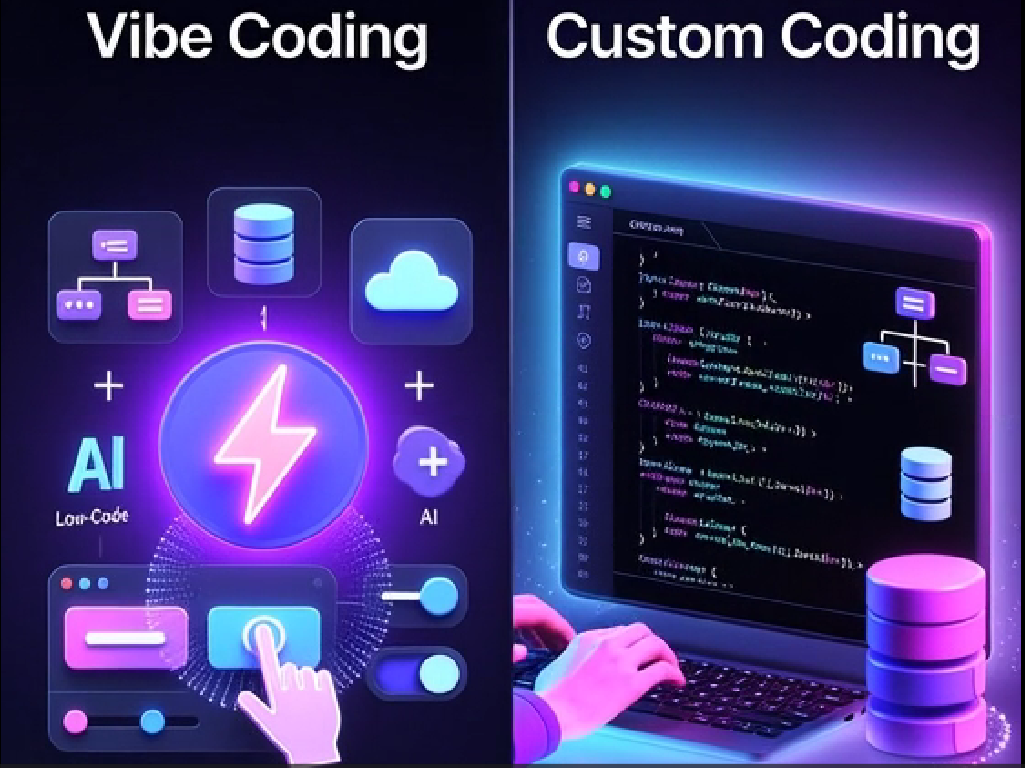
Choosing the right development approach is critical in today’s AI-driven world.
With the rise of no-code, low-code, and AI-assisted tools, a new term is gaining popularity — Vibe Coding.
At the same time, Custom Coding continues to power the world’s most scalable and secure applications.
So the big question is:
Vibe Coding vs Custom Coding — which one should you choose in 2026?
This guide breaks it down clearly for developers, startups, and business owners.
What Is Vibe Coding? (No-Code & Low-Code Explained)
Vibe Coding refers to building applications using no-code or low-code platforms, often enhanced with AI automation.
Instead of writing full codebases, developers and founders use:
- Visual builders
- Drag-and-drop components
- AI-generated logic
- Prebuilt integrations
Best Use Cases for Vibe Coding
- MVP development
- Startup validation
- Internal dashboards
- Simple SaaS tools
Benefits of Vibe Coding
- Faster development time
- Lower cost
- Less technical expertise required
- Ideal for rapid experimentation
Limitations of Vibe Coding
- Limited customization
- Performance constraints
- Vendor lock-in
- Not ideal for large-scale systems
SEO Insight: Vibe coding works best for speed, not scale.
What Is Custom Coding?
Custom Coding means building applications from scratch using programming languages like:
- JavaScript
- Python
- PHP
- Java
This approach gives full control over:
- Architecture
- Security
- Performance
- Scalability
When Custom Coding Is the Right Choice
- Enterprise software
- High-traffic applications
- Complex business logic
- Long-term products
Advantages of Custom Coding
- Full flexibility
- Better performance
- Strong security
- Scales with business growth
Challenges
- Higher development cost
- Longer timelines
- Requires experienced developers
Custom coding is slower at first, but stronger in the long run.
Vibe Coding vs Custom Coding: SEO Comparison Table
| Feature | Vibe Coding | Custom Coding |
|---|---|---|
| Development Speed | Very Fast | Moderate |
| Flexibility | Limited | Unlimited |
| Scalability | Low–Medium | High |
| Cost | Lower | Higher |
| Long-Term Control | Platform-dependent | Full ownership |
| SEO & Performance | Average | Optimized |
The Best Strategy in 2026: Hybrid Development
Top startups and tech companies don’t choose one method — they combine both.
Hybrid Development Model
- Use Vibe Coding to launch MVP quickly
- Validate product-market fit
- Transition to Custom Coding for scale
- Optimize performance, SEO, and security
This approach:
- Saves money
- Reduces risk
- Improves long-term SEO performance
How AI Is Changing Software Development
AI is transforming both approaches:
- AI writes boilerplate code
- AI accelerates debugging
- AI powers no-code platforms
- AI improves development speed
However, AI does not replace system design thinking.
The most valuable developers in 2026:
- Understand architecture
- Optimize AI-generated code
- Know when automation fails
Which One Is Best for Your Project?
Ask these questions:
- Is this a short-term MVP or long-term product?
- Do I need speed or scalability?
- Will traffic grow significantly?
Simple Decision Rule
- Idea & MVP → Vibe Coding
- Growth Phase → Custom Coding
- Scale & Enterprise → Hybrid Model
Final Verdict: Vibe Coding vs Custom Coding
There is no single winner.
⚡ Vibe Coding helps you launch faster
🛠️ Custom Coding helps you scale stronger
👉 The smartest choice in 2026 is mastering both.
Frequently Asked Questions (SEO Booster)
Is vibe coding good for startups?
Yes, vibe coding is ideal for startups to build MVPs quickly and test ideas.
Can vibe coding replace custom coding?
No. Vibe coding complements custom coding but cannot fully replace it for scalable systems.
Is custom coding still relevant in the AI era?
Absolutely. Custom coding remains essential for performance, security, and enterprise applications.
Leave a Reply