
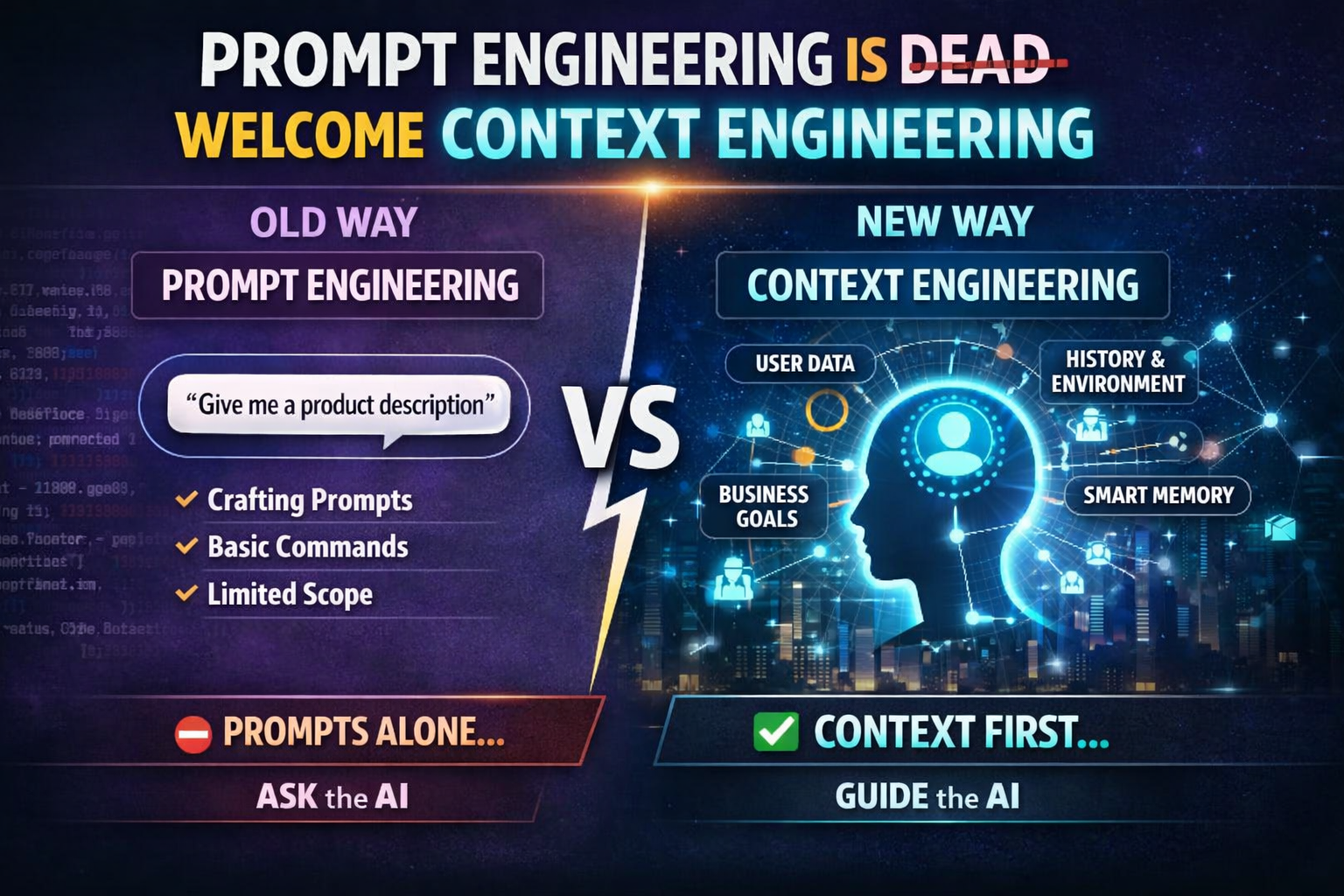
In 2026, we’re witnessing a paradigm shift in how humans work with AI — and it’s bigger than you think.
For the past few years, Prompt Engineering was the buzzword everyone talked about. People treated prompts like secret incantations: adjust a word here, switch a phrase there, and suddenly AI performs magic.
But today, we must ask a crucial question:
👉 Is Prompt Engineering enough?
The short answer: No. Prompt Engineering is dying — and Context Engineering is taking over.
🧠 What Was Prompt Engineering?
Prompt engineering was all about input phrasing — how you tell AI what to do.
For example:
✅ “Write a marketing email about a new AI tool.”
vs
❌ “Write email for product launch.”
One worked better than the other, so we learnt to optimise prompts.
But in 2026, AI models are no longer just reacting to text.
They understand situations, user history, context, constraints, and goals.
So merely crafting a good prompt isn’t enough anymore.
🚀 Enter: Context Engineering
Context Engineering is not about what you say,
but what the AI already understands about:
✅ Who the user is
✅ What problem are you trying to solve
✅ What they have already done
✅ Business goals and constraints
✅ Environment or workflow
In simple words, context trumps prompt.
📌 Why Context Matters More
Modern AI systems now leverage:
📍 User Intent Models
📍 Session History
📍 Multi-modal Understanding
📍 Task Memory and Personalization
📍 Dynamic Goal Tracking
This means the same prompt can give completely different results depending on context.
So instead of:
“Generate a product description”
We now think:
“Generate a product description tailored to a returning user, with brand tone, SEO goals, and past behavior in mind.”
That’s context engineering in action.
🔍 Real-World Example
Imagine two users:
👩 User A: Browsed vegan skincare
👨 User B: Browsed anti-aging serums
Both users ask:
➡️ “What should I buy?”
A prompt engineer might send the same optimized prompt to both.
A context engineer feeds:
✅ Browsing history
✅ Skin type preferences
✅ Previous purchases
✅ Business inventory data
And AI delivers personalised recommendations — not generic ones.
That’s the difference.
💡 What Context Engineers Actually Do
Context: engineers don’t just write prompts.
They:
➡️ Integrate AI into workflows
➡️ Build structured knowledge graphs
➡️ Use memory models
➡️ Define user segments and intents
➡️ Align AI outputs with business goals
➡️ Track outcomes and refine context over time
In short, they think holistically.
📈 The Future: AI + Human Collaboration
Prompt engineering was a stepping stone.
But context engineering is where real value emerges.
Because:
✅ Context helps AI understand
✅ Prompt alone only asks
✅ Context determines relevance
✅ And relevance drives impact
Soon, the best AI assistants will anticipate needs, not just respond.
📌 Final Thought
If you are still focused on crafting “perfect prompts”, you’re already late.
The future belongs to those who engineer context — not prompts.
Context engineering is not just a skill —
It’s a strategic advantage.
✅ Like, comment, or share if you agree — or if you’ve already started using context with AI.
👇 Let’s discuss in the comments:
How are you applying context engineering today?
Leave a Reply