
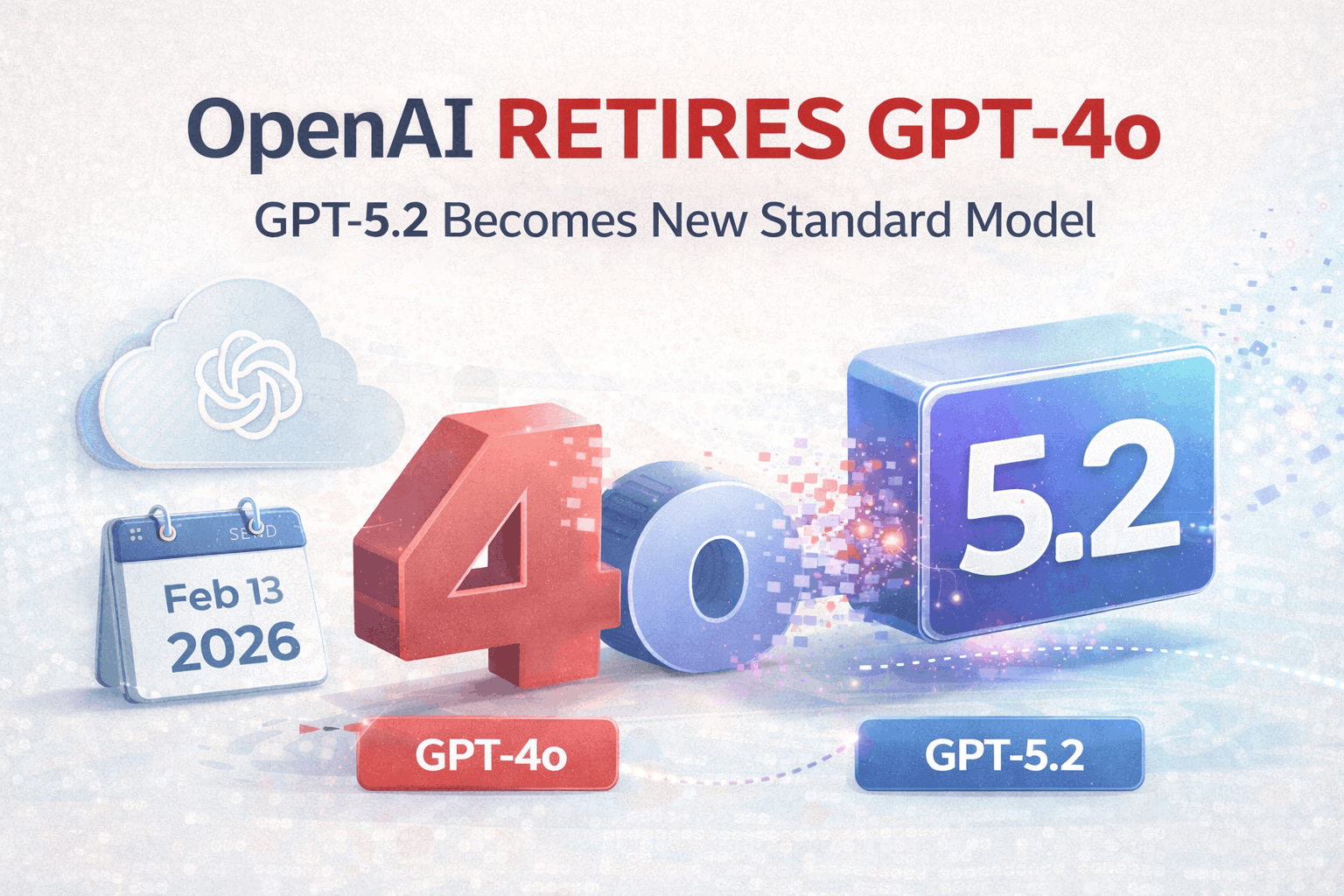
On February 13, 2026, OpenAI is officially retiring its popular GPT-4o model and several other legacy AI models from ChatGPT, shifting the platform to GPT-5.2 as the primary model for professional users. This marks a major milestone in OpenAI’s AI roadmap and reflects the rapid evolution of large language models.
📅 What’s Happening and When
OpenAI has confirmed that several models — including GPT-4o, GPT-4.1, GPT-4.1 mini, o4-mini, and GPT-5 variants — will be retired from ChatGPT on February 13, 2026. Once removed, these models will no longer be available for interactive use within the ChatGPT app, though API access for developers will remain unchanged for now.
This retirement applies specifically to the ChatGPT user experience, with OpenAI transitioning everyone to newer models by default.
💡 Why OpenAI Is Retiring GPT-4o
GPT-4o was a breakthrough multimodal model when it launched, capable of handling text, images, and audio in the same conversation. It quickly became a favorite for creative tasks and conversational workflows, thanks to its personable and intuitive style. However:
- Model usage has shifted toward newer AI systems.
- GPT-4o accounts for a tiny fraction of active use compared to advanced models like GPT-5.1 and GPT-5.2.
- OpenAI wants to consolidate development efforts on models that deliver the best performance, reliability, and utility across tasks.
Despite this, OpenAI did listen to initial user feedback in 2025 — it previously restored GPT-4o after backlash when it was first slated for retirement, acknowledging how many users relied on it for ideation and creative work.
🚀 Meet GPT-5.2: The New Standard
GPT-5.2 — released in December 2025 — is now positioned as OpenAI’s flagship model for professional and advanced use cases. It succeeds earlier GPT-5 and GPT-5.1 generations and brings several improvements:
Key Highlights of GPT-5.2
- State-of-the-art reasoning: Improved capabilities in logical reasoning and complex tasks.
- Enhanced performance: Faster and more reliable than prior models across text, planning, and decision-heavy workflows.
- Better customization: Offers selectable personality styles and adjustable conversational tone without extra prompt engineering.
- Higher accuracy on professional workloads: Benchmarks suggest improved handling of data-intensive and reasoning tasks compared to earlier GPT models.
Unlike GPT-4o, GPT-5.2 is designed to combine creativity, reasoning, and task precision, making it well-suited for developers, analysts, researchers, and enterprise applications.
📊 What Changes for Users
Here’s how the retirement affects different user groups:
🔹 ChatGPT Users
- After February 13, models like GPT-4o will no longer be selectable in the ChatGPT interface.
- Conversations using those older models will automatically default to closest GPT-5.2 equivalents.
- Users may see slight differences in style or tone when continuing past chats.
🔹 API Developers
- Legacy models will continue to be available through the API for now — giving developers time to adjust systems and integrations.
🧠 Community Reactions
The announcement sparked mixed feedback:
- Supporters see this as a necessary step toward better, more powerful AI and streamlined model choices.
- Some users expressed disappointment, especially those who preferred GPT-4o’s conversational tone and use in creative writing or emotional support contexts.
OpenAI has acknowledged that losing access to GPT-4o may feel disappointing for some, especially longtime users, while emphasizing the benefits of advancing to next-gen AI.
📌 Final Thoughts
The retirement of GPT-4o and other legacy models marks a clear turning point in how AI evolves from early experimentation to professional-grade tools. With GPT-5.2 as the new backbone of ChatGPT and professional workflows:
- Developers and creators can expect more capable reasoning.
- Enterprises get a more robust platform for knowledge and research tasks.
- The model lineup becomes simpler and more future-focused.
Leave a Reply