
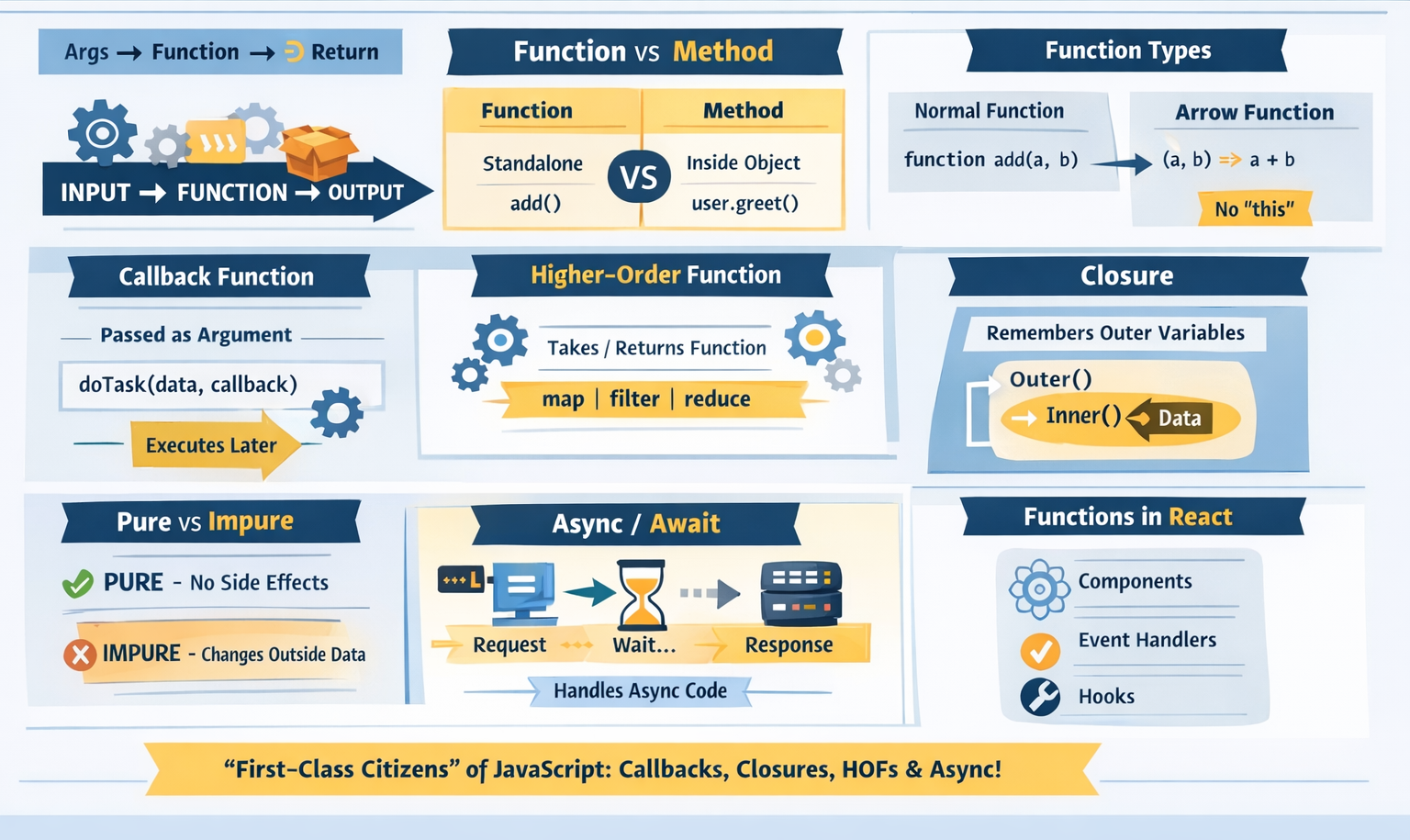
In this blog, we’ll break down all important function concepts using simple explanations, real examples, and visual thinking.
🔹 What Is a Function in JavaScript?
A function is a block of reusable code that:
- Takes input (arguments)
- Processes logic
- Returns output
function add(a, b) {
  return a + b;
}
📌 Think of a function like a machine:
Input → Process → Output
🔹 Function vs Method (Very Important)
✅ Function
A function works independently.
function greet() {
  console.log("Hello");
}
✅ Method
A method is a function inside an object.
const user = {
  name: "Vibha",
  greet() {
    console.log("Hello " + this.name);
  }
};
🧠 Key Difference
A method belongs to an object, a function does not.
🔹 Types of Functions
1️⃣ Normal Function
function multiply(a, b) {
  return a * b;
}
✔ Has its own this
2️⃣ Arrow Function
const multiply = (a, b) => a * b;
❌ Does NOT have its own this
🔥 Widely used in React
🔹 Callback Function
A callback function is passed as an argument and executed later.
function processData(data, callback) {
  callback(data);
}

processData("Hello", message => {
  console.log(message);
});
📌 Used in:
- Event handling
- API calls
- Timers (
setTimeout)
🔹 Higher-Order Functions (HOF)
A function that:
- Takes another function as input OR
- Returns a function
const numbers = [1, 2, 3];

const doubled = numbers.map(n => n * 2);
Common HOFs:
map()filter()reduce()
🔹 Closures (Most Powerful Concept 🔥)
A closure allows a function to remember variables from its outer scope.
function counter() {
  let count = 0;

  return function () {
    count++;
    return count;
  };
}

const increment = counter();
increment(); // 1
increment(); // 2
📌 Used in:
- React hooks
- Data privacy
- Memoization
🧠 Interview Line
A closure gives access to an outer function’s variables even after execution.
🔹 Pure vs Impure Functions
✅ Pure Function
- Same input → same output
- No side effects
function square(x) {
  return x * x;
}
❌ Impure Function
- Modifies external data
let total = 0;

function add(num) {
  total += num;
}
🔥 React prefers pure functions for predictable UI.
🔹 Async / Await (Modern JavaScript)
Async functions handle non-blocking operations like API calls.
async function fetchUser() {
  const response = await fetch("/api/user");
  const data = await response.json();
  return data;
}
✔ Cleaner than .then()
✔ Easier error handling
✔ Essential for backend & frontend
🔹 Functions in React
In React, everything is built on functions.
✔ Functional Components
const Button = () => {
  return <button>Click Me</button>;
};
✔ Event Handlers (Callbacks)
<button onClick={() => alert("Clicked!")}>Click</button>
✔ Hooks (Closures)
Hooks like useState rely on closures internally.
🔑 Why Functions Matter So Much
- Core of JavaScript
- Foundation of React & Node.js
- Frequently asked in interviews
- Enable clean, reusable, scalable code
🎯 Final Takeaway
JavaScript functions are first-class citizens that enable callbacks, closures, higher-order programming, and async workflows — making modern web development possible.
If you master functions, frameworks become easy.



Leave a Reply