
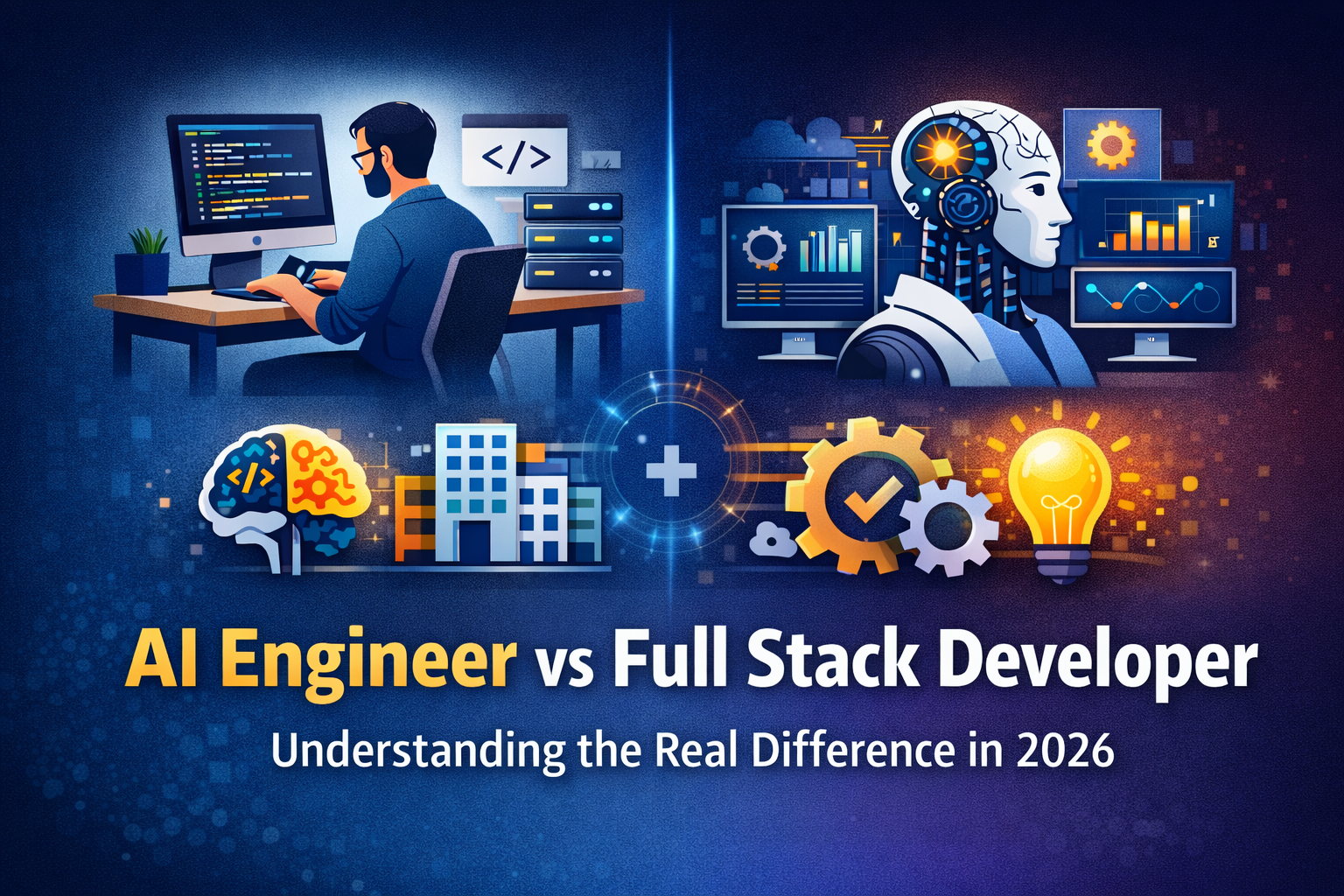
Technology is evolving faster than ever. With Artificial Intelligence becoming mainstream, one question keeps coming up:
Should you become a Full Stack Developer or an AI Engineer?
Or even more importantly —
Is AI replacing traditional developers?
Let’s break it down clearly.
What is a Full Stack Developer?
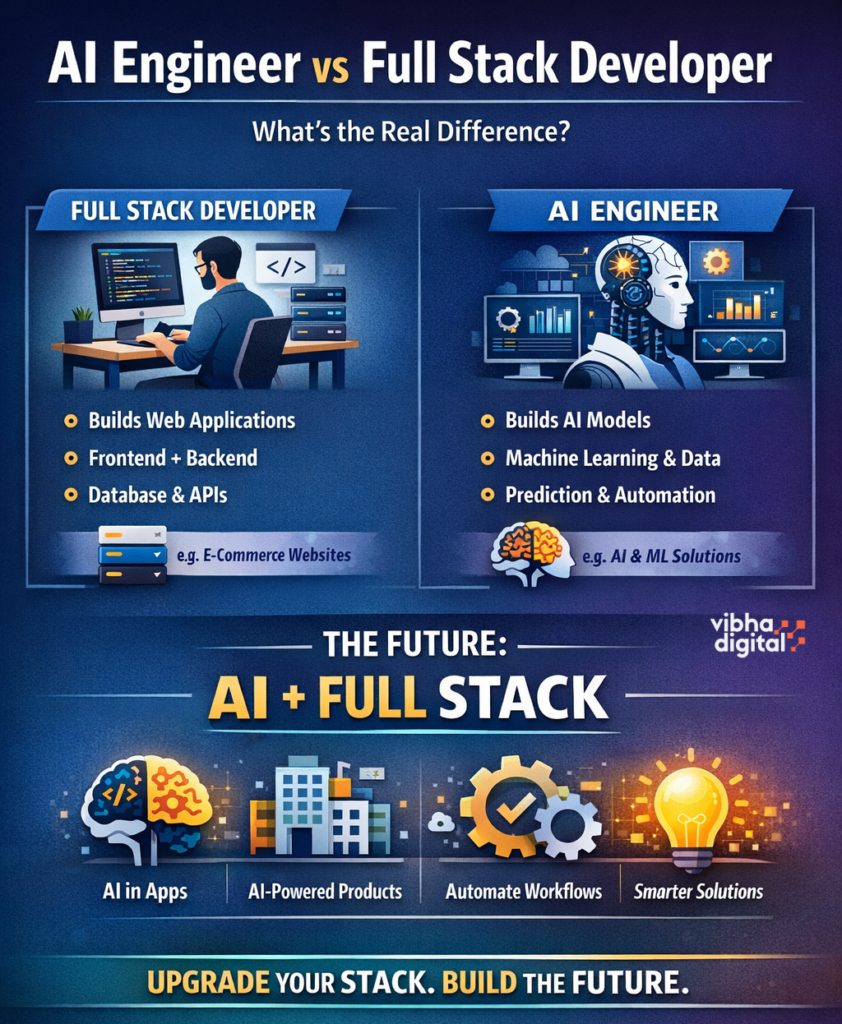
A Full Stack Developer builds complete web applications — handling everything from the user interface to backend systems and databases.
Core Responsibilities:
- Designing responsive user interfaces (Frontend)
- Building server-side logic (Backend)
- Managing databases
- Creating and consuming APIs
- Deploying applications to cloud or servers
Common Tech Stack:
- HTML, CSS, JavaScript
- React / Next.js
- Node.js / PHP / Python
- MySQL / MongoDB
- AWS / Vercel / DigitalOcean
Primary Focus:
Performance, scalability, usability, and system architecture.
In simple terms:
A Full Stack Developer builds systems that work.
What is an AI Engineer?
An AI Engineer focuses on building intelligent systems that can learn from data and make decisions.
Core Responsibilities:
- Training machine learning models
- Working with large datasets
- Developing prediction systems
- Creating automation pipelines
- Integrating AI models into applications
Common Tech Stack:
- Python
- Machine Learning frameworks
- Deep Learning libraries
- Data processing tools
- AI APIs
Primary Focus:
Data, intelligence, prediction, and automation.
In simple terms:
An AI Engineer builds systems that think.
Key Differences Between AI Engineer and Full Stack Developer
| Area | Full Stack Developer | AI Engineer |
|---|---|---|
| Main Goal | Build applications | Build intelligence |
| Focus | UI + Backend + Database | Data + Models |
| Output | Web / SaaS products | Prediction systems |
| Skills | Web frameworks | Machine learning |
| Thinking Style | System architecture | Mathematical modeling |
Both roles are powerful — but they solve different types of problems.
Is AI Replacing Full Stack Developers?
Short answer: No.
AI is not replacing developers.
AI is changing how developers build.
Today, companies need:
- Web apps with AI chatbots
- E-commerce sites with smart recommendations
- SaaS platforms with automation
- Dashboards with predictive analytics
This is where the real opportunity lies.
The Rise of the AI-Integrated Full Stack Developer
The most valuable professionals in 2026 are not choosing one side.
They are combining both.
An AI-Integrated Full Stack Developer can:
- Embed AI APIs into web apps
- Build AI-powered SaaS platforms
- Automate workflows
- Create intelligent user experiences
- Develop end-to-end AI products
This hybrid skill set is becoming highly attractive globally.
Which Career Path Should You Choose?
Choose Full Stack Development if:
- You enjoy building products end-to-end
- You like UI/UX + backend architecture
- You want faster entry into tech
Choose AI Engineering if:
- You enjoy mathematics and data
- You like solving prediction problems
- You are comfortable with Python and statistics
Choose Both (Strategic Growth Path):
If you already have web development experience, adding AI integration skills is a powerful upgrade.
Instead of switching careers completely, you can:
- Start learning AI fundamentals
- Integrate AI APIs into your projects
- Build small AI-powered tools
- Gradually move into intelligent product development
Salary & Global Demand Perspective
Globally, both roles are in high demand.
- Full Stack Developers are essential for product development.
- AI Engineers are critical for innovation and automation.
However, professionals who can bridge AI and product development often command higher opportunities because they understand both system architecture and intelligence layers.
Final Thoughts
The future is not:
AI vs Developers.
The future is:
AI + Developers.
Technology will continue evolving. The smartest move is not abandoning your current skills — but upgrading them.
If you are a developer today, learning how to integrate AI into your stack could be the most strategic decision you make this decade.
Leave a Reply