
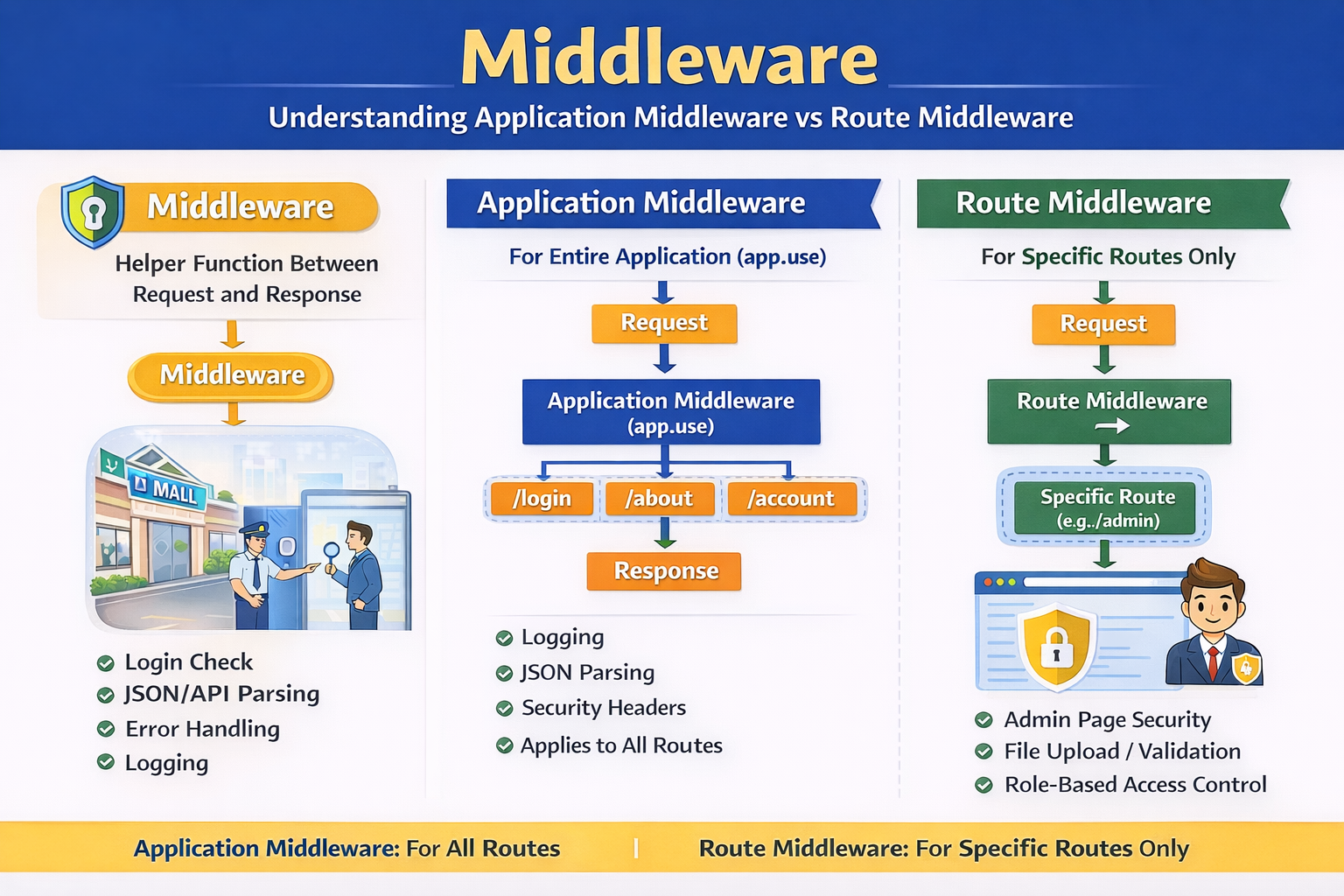
Middleware is one of the most powerful and essential concepts in Node.js and Express.js. While beginners often see it as “just another function,” experienced developers understand middleware as a core architectural layer that enables scalability, security, and maintainability.
This blog explains:
- What middleware is
- Application vs Route middleware
- When and why to use each
- Best practices for production systems
What Is Middleware?
In Express.js, middleware is a function that executes between an incoming request and the outgoing response.
It has access to:
request(req)response(res)next()— which passes control to the next middleware or route
Middleware allows developers to intercept, modify, validate, or block requests before they reach business logic.
Common Responsibilities of Middleware
- Authentication & authorization
- Request logging
- Input validation
- JSON parsing
- Error handling
- Security headers
Application Middleware
Application middleware runs for every request in the application. It is defined using:
app.use(middlewareFunction);
Characteristics
- Global scope
- Executes before all routes
- Ideal for cross-cutting concerns
Common Use Cases
- Logging & monitoring
- Parsing JSON bodies
- Authentication pre-checks
- Security headers
- Centralized error handling
Example
app.use((req, res, next) => {
  console.log(`${req.method} ${req.url}`);
  next();
});
Every request—/login, /users, /products—passes through this middleware.
Route Middleware
Route middleware applies only to specific routes or route groups.
It is used when certain endpoints require extra logic or protection.
Characteristics
- Scoped to selected routes
- More granular control
- Improves security and clarity
Common Use Cases
- Admin-only routes
- Role-based access control
- File upload validation
- Feature-specific logic
Example
const isAdmin = (req, res, next) => {
  if (req.user.role === 'admin') {
    next();
  } else {
    res.status(403).send('Access denied');
  }
};

app.get('/admin', isAdmin, (req, res) => {
  res.send('Welcome Admin');
});
Only the /admin route uses this middleware.
Application vs Route Middleware (Quick Comparison)
| Feature | Application Middleware | Route Middleware |
|---|---|---|
| Scope | Entire application | Specific routes |
| Use case | Global logic | Route-specific logic |
| Security | General | Fine-grained |
| Example | Logging, parsing | Admin access |
Why Middleware Design Matters in Production
In real-world applications, poor middleware structure leads to:
- Code duplication
- Security gaps
- Hard-to-maintain APIs
Well-structured middleware:
✔ Keeps business logic clean
✔ Improves API consistency
✔ Enhances scalability
✔ Simplifies debugging and monitoring
In larger systems, middleware acts as a policy enforcement layer, ensuring predictable behavior across services.
Best Practices for Middleware Architecture
- Keep middleware small and focused
- Separate global and route-specific logic
- Always call
next()(or end the response) - Centralize error handling
- Avoid heavy logic in middleware
- Document middleware behavior clearly
Final Thoughts
Middleware is not just an Express.js feature—it’s a design pattern that shapes how backend systems behave at scale.
Mastering middleware helps developers build:
- Secure APIs
- Clean architectures
- Production-ready systems
Whether you’re a beginner or an experienced developer, understanding middleware deeply is a major step toward professional backend engineering.





Leave a Reply