
The Evolution of Generative AI
The journey of generative AI has been remarkable, tracing back to its nascent stages where the primary focus lay on text generation. Early models, such as Eliza and GPT-2, showcased the potential of machines to comprehend and generate human-like text. These pioneering technologies were pivotal in illustrating how computers could assist in writing, dialogue simulation, and even content creation, marking the genesis of generative AI.
By employing various methodologies, these early generative models enabled creators to explore numerous applications. From aiding authors in brainstorming to powering chatbots for customer service, generative AI began reshaping various sectors, including education, entertainment, and marketing. However, while they provided innovative solutions, these tools had significant limitations. Most notably, they operated reactively, generating outputs based solely on the input they received without understanding the deeper context or implications of the content produced.
The foundation technologies that facilitated the rise of generative AI include neural networks and deep learning, which have evolved dramatically over the years. These approaches allowed for more sophisticated algorithms that could learn patterns within vast datasets, improving the ability to generate coherent and contextually relevant content. Despite their advancements, challenges continued to persist, particularly concerning the quality and reliability of the outputs. Early generative models occasionally produced biased or nonsensical results, necessitating ongoing adjustments and training.

As the field progressed, the evolution of generative AI laid the groundwork for subsequent innovations. Understanding how these initial tools functioned and the inherent limitations they presented is crucial for comprehending the broader trajectory of artificial intelligence development. The knowledge gained during this phase offers invaluable insights as the technology moves toward more complex and agentic forms of AI.
Understanding Agentic AI: The New Frontier
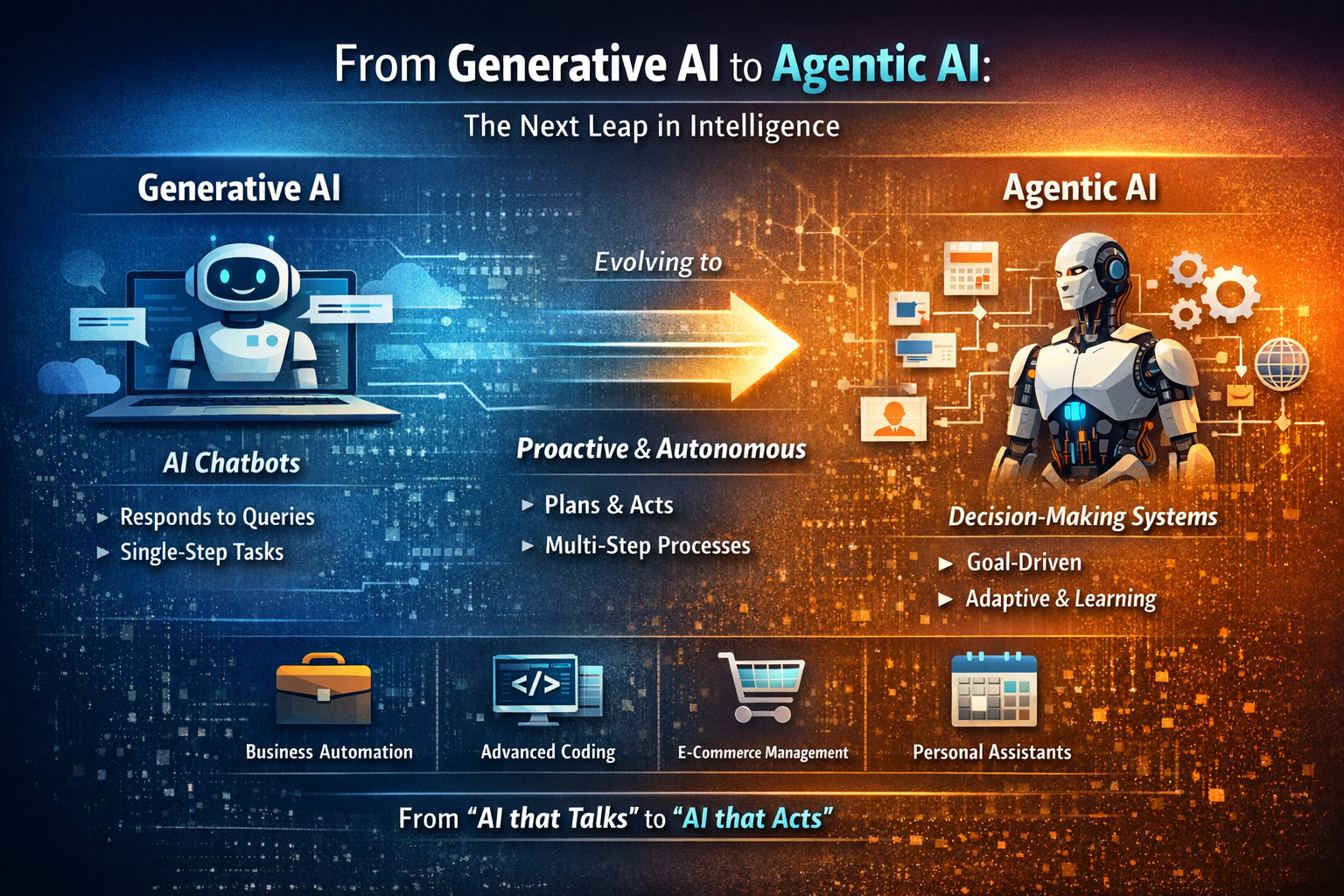
Agentic AI represents a significant evolution in the domain of artificial intelligence, marking a clear distinction from its predecessor, generative AI. While generative AI is characterized by its ability to produce content based on existing data patterns, agentic AI takes a step further by incorporating elements of autonomy and complex decision-making into its operations. This transformative shift allows agentic AI to perform tasks with a degree of independence akin to human cognition.
One of the defining features of agentic AI is its ability to make independent decisions. Unlike traditional generative AI systems that primarily operate under user input or predefined instructions, agentic AI can analyze situations and determine an optimal course of action based on its learned experiences. This independence not only enhances its usability in diverse contexts but also allows for more dynamic interactions that can adapt to evolving circumstances.
Furthermore, agentic AI excels in executing multi-step tasks that require a sequence of actions to achieve a specific goal. This capability is indicative of a higher level of operational complexity, where the system must plan, execute, and adjust its strategies in response to real-time feedback. By engaging in iterative learning, agentic AI continually refines its processes and improves performance, providing a feedback loop that is essential for growth and adaptability.
In distinguishing agentic AI from traditional forms of artificial intelligence, it’s essential to emphasize its capacity for problem-solving and interaction that closely mirrors human-like capabilities. Such advancements position agentic AI not only as a tool but also as a partner in tackling complex challenges, opening new avenues for innovation across various sectors.
Key Differences Between Generative AI and Agentic AI
Generative AI and agentic AI represent two distinct approaches within the field of artificial intelligence, each with unique operational paradigms and capabilities. One of the first notable differences lies in their operational styles. Generative AI is primarily reactive; it generates outputs based on the inputs it receives. This means it processes a given prompt to produce relevant responses, but it cannot take initiative on its own. In contrast, agentic AI operates in a proactive manner, allowing it to set goals and make autonomous decisions based on the context of the situation.
Another critical difference is their response structures. Generative AI typically engages in single-step processing, where it responds to queries or commands one interaction at a time. This limits its ability to engage in complex problem solving that requires deeper reasoning or sequential decisions. Conversely, agentic AI utilizes a multi-step response structure, enabling it to evaluate a situation, assess various possibilities, and formulate a series of actions that can lead to achieving its objectives. This capability allows agentic AI to handle more intricate tasks that demand an advanced level of reasoning.
Lastly, memory capabilities further distinguish generative AI from agentic AI. Generative AI often lacks sophisticated memory functions, retaining only short-term context for the immediate interaction. This makes it challenging to maintain continuity in conversations or tasks that require long-term information retention. On the other hand, agentic AI possesses enhanced memory capabilities, allowing it to recall previous interactions and learn over time. This evolving memory system allows agentic AI to adapt its responses and improve its overall performance based on past experiences, making it a significant advancement over generative AI.
The Future Implications of Agentic AI
The emergence of agentic AI technology heralds a significant evolution in the landscape of artificial intelligence, bringing forth a multitude of implications across various sectors. Unlike traditional AI systems, which are predominantly reactive, agentic AI possesses the ability to operate autonomously, making decisions based on its programming and learned experiences. This newfound autonomy opens up a range of potential applications—from improving operational efficiencies in manufacturing to transforming customer service through intelligent virtual assistants.
As various industries begin to integrate agentic AI, ethical considerations must be at the forefront of this technological evolution. The delegation of decision-making authority to autonomous systems raises critical questions regarding accountability and bias. Ensuring that these systems are designed transparently and operate equitably will be essential in fostering public trust. Additionally, regulatory frameworks will need to evolve to address the complexities of agentic AI, particularly concerning data privacy and the implications of machine autonomy.
Furthermore, the rise of agentic AI will likely redefine the dynamics of human-machine collaboration. By assuming more complex tasks, these intelligent agents can augment human capabilities, driving innovations in teamwork across various professional domains. For instance, in sectors such as healthcare, agentic AI could assist clinicians with diagnostic processes, ultimately enhancing patient outcomes. However, this integration will also bring challenges, particularly concerning the potential displacement of specific job functions. Workers may need to adapt to new roles that emphasize creativity and strategic thinking—attributes that, at least for now, remain uniquely human.
In exploring the future implications of agentic AI, it is evident that while the technology presents significant opportunities for advancements and efficiencies, it concurrently poses challenges that society must navigate thoughtfully. The ongoing discourse around these issues is imperative as we envision a future where intelligent systems become an inherent part of our daily lives.

Leave a Reply